
 Read on Twitter
Today @USCBO released its projections for $15/2025 min wage. Here are some thoughts on their employment estimate.
Tl;dr. They used same evidence (11 studies) as 2019 report but UPweighted more negative studies; the implied OWE=-0.48 instead of -0.38
https://www.cbo.gov/system/files/2021-02/56975-Minimum-Wage.pdf
Tl;dr. They used same evidence (11 studies) as 2019 report but UPweighted more negative studies; the implied OWE=-0.48 instead of -0.38
https://www.cbo.gov/system/files/2021-02/56975-Minimum-Wage.pdf
In the 2019 they used 11 studies, and found the median "directly affected employment" elasticities (closely related to the own-wage elasticity of employment) of around -0.25. Then they multiplied by 1.5 to capture "long run" effects, getting -0.38.

This time, they used the same elasticities, but now decided to not use the median elasticity but simulate the mean employment effect by randomly drawing from these elasticities. Change of this method leads to 1.4 million job loss instead of 1.1 million using old approach.
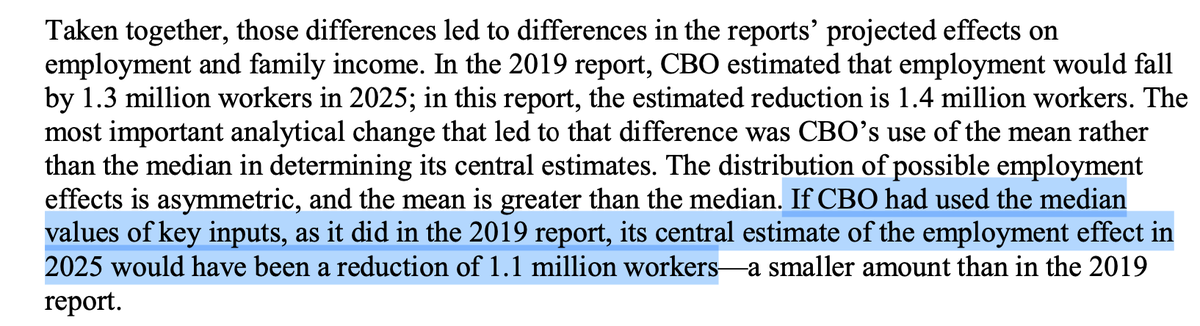
CBO's implied OWE is now around -0.48 (= -0.38 x 1.4 / 1.1).
I felt -0.38 was already somewhat too negative based on my comprehensive 2019 review conducted for @hmtreasury. The comparable OWE (broad group) was -0.04. (-0.14 incl narrow groups)
-0.48 goes in wrong direction.
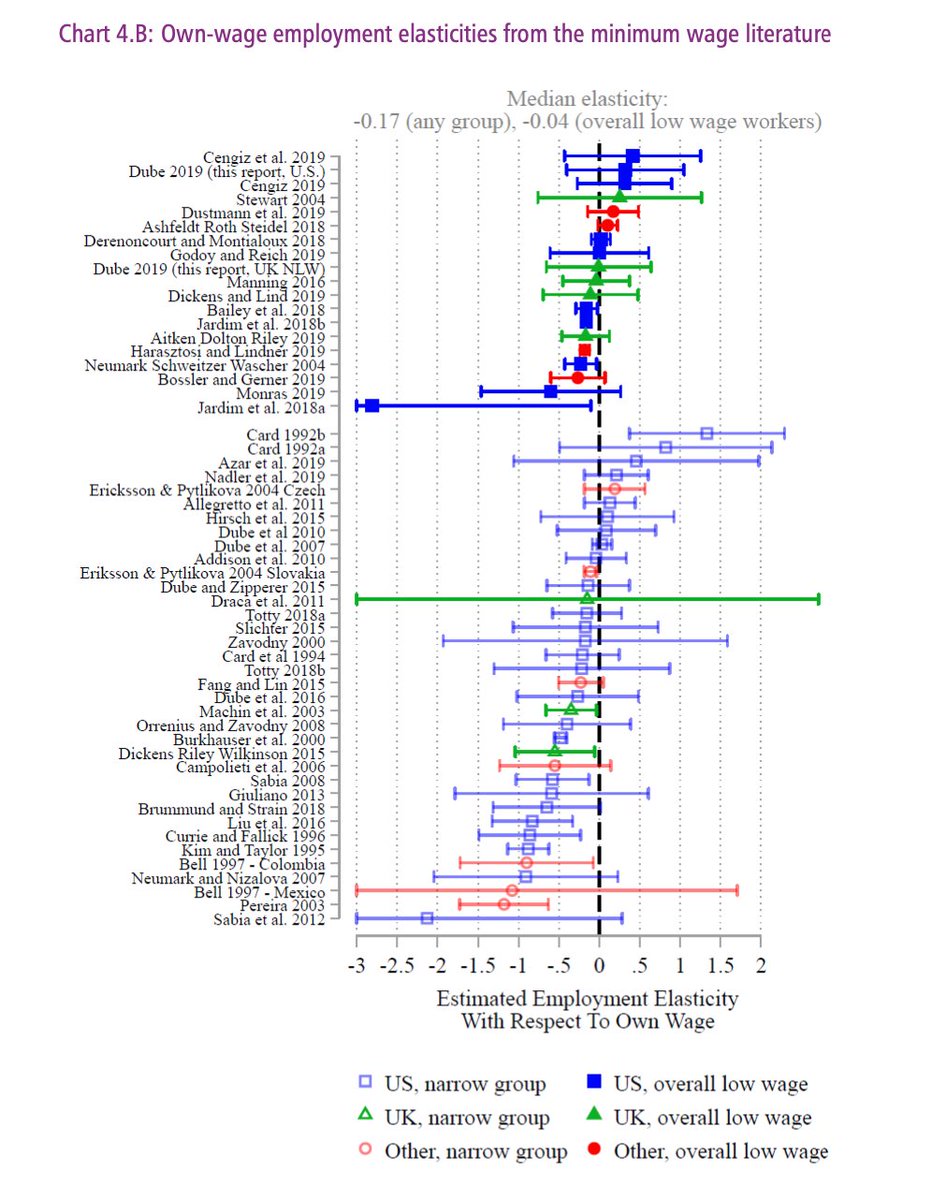
I felt -0.38 was already somewhat too negative based on my comprehensive 2019 review conducted for @hmtreasury. The comparable OWE (broad group) was -0.04. (-0.14 incl narrow groups)
-0.48 goes in wrong direction.
The new CBO averaging implicitly puts more weight on some of the most negative estimates, including the Seattle study by Jardim et al. However, in our new JEP paper, we show evidence from 21 major city minimum wage (incl Seattle) and find an OWE of -0.12. https://www.aeaweb.org/articles?id=10.1257/jep.35.1.27
Importantly, we can replicate a similar pattern as in the Seattle study suggesting large losses in jobs below a threshold (but unrealistic big job gains at very top) from our 21 city case *when we don't factor in that these cities were experiencing very high wage growth.*
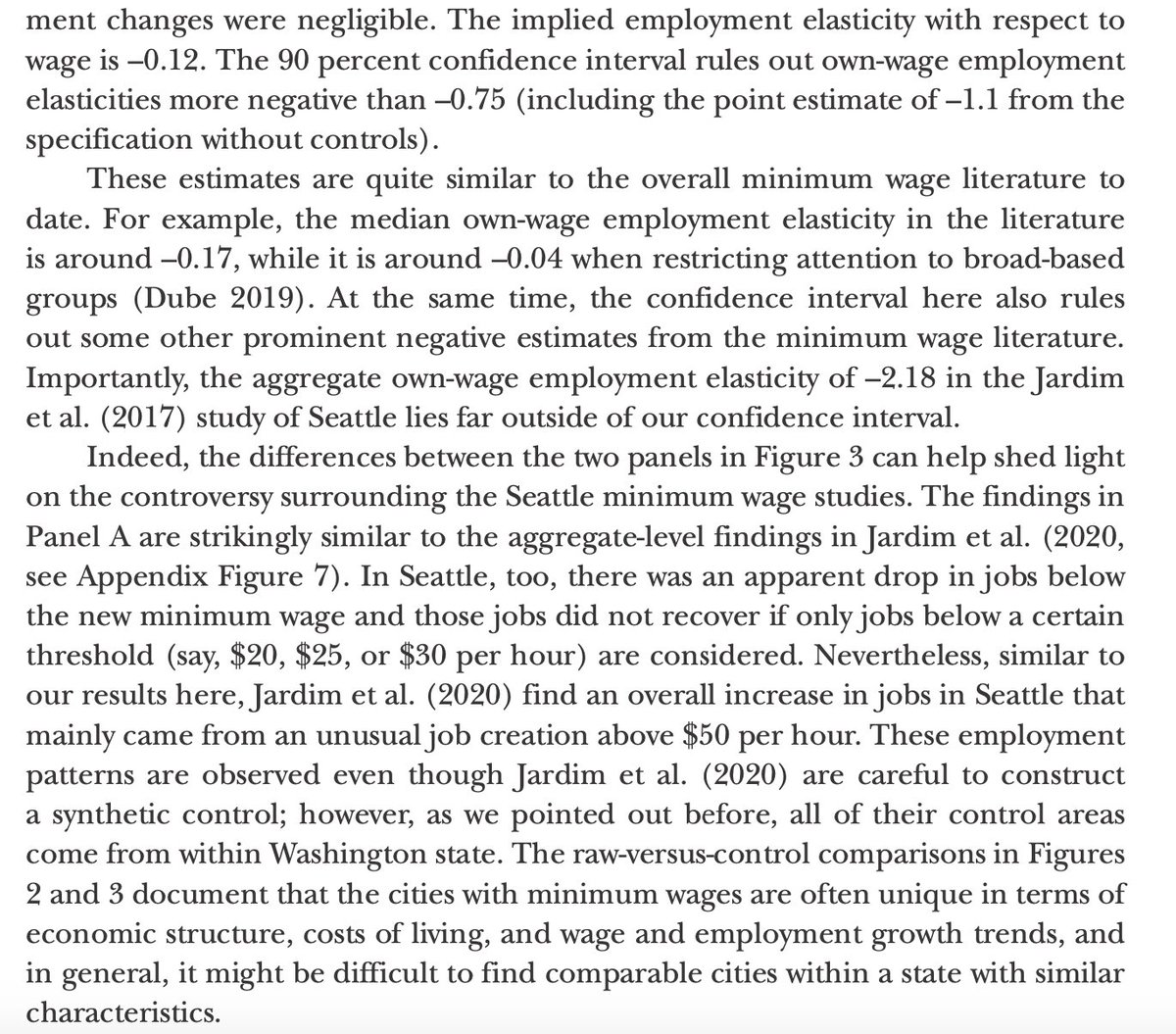

So, the research evidence since 2019 has provided more information about why the very large negative effect from the Jardim et al study likely overstates the true employment effect. However, the CBO increased the implicit weight put on that study through change in its methods.
At the end of the day, the CBO estimates still suggest wage gains are >> job losses, and reduced poverty. However, I think the CBO's choices here move it in the wrong direction when it comes to reliable aggregation of the best evidence on the overall emp effect of min wages.
\\fin
\\fin
Another historical data point to consider. Here are the implicit OWE's used by various CBO minimum wage projections as best I can tell:
2014: -0.16
2019: -0.38
2021: -0.48
These are somewhat different policies, but I'm concerned how CBO is updating based on new research.
2014: -0.16
2019: -0.38
2021: -0.48
These are somewhat different policies, but I'm concerned how CBO is updating based on new research.
Background: For those not in the weeds, here is an explanation of the "own-wage elasticity" of employment for minimum wage studies; this is closely related to what the CBO uses. https://twitter.com/arindube/status/1191359440143953921


