
 Read on Twitter
Here’s a #tweetorial about extremes of #physiology that are very much "compatible with life".
Case #1. You are called about a critical drop in platelets.
Platelet Count (x10^3/uL)
Previous 475
Current 45
It’s nothing to worry about. This sample came from a ___.
Case #1. You are called about a critical drop in platelets.
Platelet Count (x10^3/uL)
Previous 475
Current 45
It’s nothing to worry about. This sample came from a ___.
Answer 
To avoid VTE while hibernating, squirrels drop their Plt counts 10x! They also vWF & Factors VIII/IX
Red tailed have Plt counts ~750 as fawns that drop to ~250 as adults (over yrs)
Stepping on a Lonomia is a medical emergency. It *CAUSES* thrombocytopenia/DIC!


To avoid VTE while hibernating, squirrels drop their Plt counts 10x! They also
vWF & Factors VIII/IXRed tailed
have Plt counts ~750 as fawns that drop to ~250 as adults (over yrs)Stepping on a Lonomia
is a medical emergency. It *CAUSES* thrombocytopenia/DIC!
Case #2: You get a call from bedside nurse about an abnormal blood pressure:
BP 330/240
You reassure him, that's a totally OK blood pressure because it was measured in a ___.
BP 330/240
You reassure him, that's a totally OK blood pressure because it was measured in a ___.
Answer: 
have the highest BP of any extant species, an adaptation to perfuse their  atop 2m necks.

 is very viscous (no RBCs, just protein) so their BPs run high for invertebrates (70s/30s) *BUT* they go into CARDIAC ARREST w/ exercise
 can develop HTN w/ BPs170s/150s


have the highest BP of any extant species, an adaptation to perfuse their atop 2m necks.is very viscous (no RBCs, just protein) so their BPs run high for invertebrates (70s/30s) *BUT* they go into CARDIAC ARREST w/ exercisecan develop HTN w/ BPs170s/150s
Bonus answer: 
If you think that’s a high BP, long-necked dinosaurs (Barosaurus & Brachiosaurus) were once thought to have SBP >700mmHg with head raised. This would have required a 1000+ kg heart. More likely it didn’t raise its head but used it to forage while swimming.


If you think that’s a high BP, long-necked dinosaurs (Barosaurus & Brachiosaurus)
were once thought to have SBP >700mmHg with head raised. This would have required a 1000+ kg heart. More likely it didn’t raise its head but used it to forage while swimming.
 Point: “normal” BP depends on position. Because humans walk upright our BP must be higher.
This is why orthostatic BP is so useful.
Also, in case you were wondering, taller people *do* have slightly higher BP (in the NHANES dataset at least). https://www.ncbi.nlm.nih.gov/pmc/articles/PMC5815765/#!po=32.3529
Case 3: Now you are called by the hematology lab about a critical value on a CBC:
WBC 5
Hb 0
Hct 0
RBC 0
Platelet 150
You tell the lab "It’s cool. Nothing to worry about because the sample came from ____."
WBC 5
Hb 0
Hct 0
RBC 0
Platelet 150
You tell the lab "It’s cool. Nothing to worry about because the sample came from ____."
Answer: 
Icefish (channichthyidae literally means white blood fish) are the only vertebrates w/o hemoglobin
They survive by combining high SV (5x larger heart), big capillaries (low SVR), & increased O2 solubility in the arctic ocean. They also don’t do very much (lower VO2).


Icefish (channichthyidae literally means white blood fish) are the only vertebrates w/o hemoglobin
They survive by combining high SV (5x larger heart), big capillaries (low SVR), & increased O2 solubility in the arctic ocean. They also don’t do very much (lower VO2).
Other answers:
Thehas hemocyanin, an O2 binding metalloprotein w/ Cu instead of Fe
The Opah is the only warm blooded ; it actually uses more O2
The vampire is adapted to the O2 minimum zone (O2 sat 3%); w/ large gills & O2 avid hemocyanin it extracts >90% of dissolved O2
The
has hemocyanin, an O2 binding metalloprotein w/ Cu instead of FeThe Opah is the only warm blooded
; it actually uses more O2The vampire
is adapted to the O2 minimum zone (O2 sat 3%); w/ large gills & O2 avid hemocyanin it extracts >90% of dissolved O2
Turns out FiO2 is pretty important if you don’t have lungs
300 million years ago, insects were *much* bigger. Imagine a dragonfly the size of a seagull (2.5 foot wingspan).
Why? Atmospheric FiO2 was in the Paleozoic period: 35% compared to 21% today. https://www.eurekalert.org/pub_releases/2006-10/aps-gim100706.php
300 million years ago, insects were *much* bigger. Imagine a dragonfly the size of a seagull (2.5 foot wingspan).
Why? Atmospheric FiO2 was
in the Paleozoic period: 35% compared to 21% today. https://www.eurekalert.org/pub_releases/2006-10/aps-gim100706.php
Rarely people survive very low hemoglobin too:One person survived a Hb of 1.8 g/dL w/o transfusion & another survived Hb of 0.7 g/dL.
Like the animal kingdom examples, this is possible due to
FiO2, SV, SVR, O2 extraction, & O2 consumption (& also a lot of luck)


Case 4: Your  just keeps on going off! Now you are getting paged about an abnormal urinalysis result.
Urine Osm 9000
SG > 1.060
That’s expected because it came from a ____.
just keeps on going off! Now you are getting paged about an abnormal urinalysis result.Urine Osm 9000
SG > 1.060
That’s expected because it came from a ____.
Answer: 
Humans can concentrate our urine to ~1200 mOsm/L
Dolphins reach ~1700 but contrary to belief they can’t drink seawater
Camels reach 2800 mOsm/L but dessert rodents are the champs. Chinchilla go without for weeks & concentrate urine >7500 mOsm/L. That’s a SG > 1.060!
Humans can concentrate our urine to ~1200 mOsm/L
Dolphins reach ~1700 but contrary to belief they can’t drink seawater
Camels reach 2800 mOsm/L but dessert rodents are the champs. Chinchilla go without
for weeks & concentrate urine >7500 mOsm/L. That’s a SG > 1.060!
: Don’t underestimate dehydration in people “found down"We lose >1.2L/day insensibly (& more if sweating). Life-threatening dehydration occurs w/i DAYS at rest or HOURS with activity
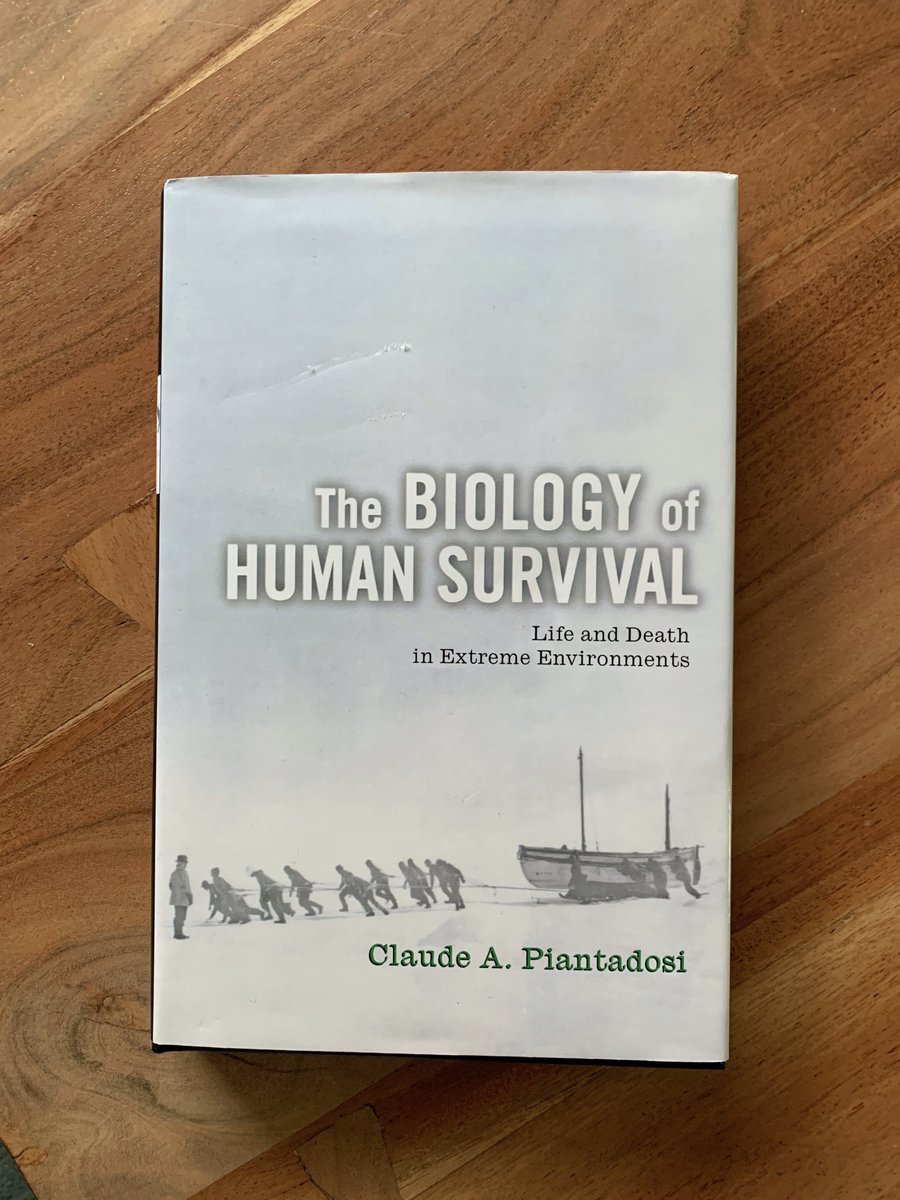
Thanks to @robertpdickson for recommended this great
 ; it even discusses survival on Arrakis

I hope you’ve enjoyed this extremes of #physiology #tweetorial part deux. If so, you may also enjoy my prior on the topic.
https://twitter.com/nickmmark/status/1346589425938010112
I’ve tried to sneak in some useful clinical take-home () learning points too. If you have ideas for future topics please comment.
on the topic.https://twitter.com/nickmmark/status/1346589425938010112
I’ve tried to sneak in some useful clinical take-home (
) learning points too. If you have ideas for future topics please comment.


