
 Read on Twitter
[NEW STUDY] The ocean’s twilight zone could contain huge new #fisheries, but we don’t know much about these species and ecosystems.
So are we ready to effectively manage such a fishery?
 https://tinyurl.com/y2l6vjub
#Thread
By @MarinePolicy
cc @4kgjerde
![[NEW STUDY] The ocean’s twilight zone could contain huge new #fisheries, but we don’t know much about these species and ecosystems. So are we ready to effectively manage such a fishery? https://tinyurl.com/y2l6vjub #Thread By @MarinePolicy cc @4kgjerde](https://pbs.twimg.com/media/EnQmYXJWMAIWFLo.jpg "[NEW STUDY] The ocean’s twilight zone could contain huge new #fisheries, but we don’t know much about these species and ecosystems. So are we ready to effectively manage such a fishery? https://tinyurl.com/y2l6vjub #Thread By @MarinePolicy cc @4kgjerde")
So are we ready to effectively manage such a fishery?
https://tinyurl.com/y2l6vjub #Thread
By @MarinePolicy
cc @4kgjerde
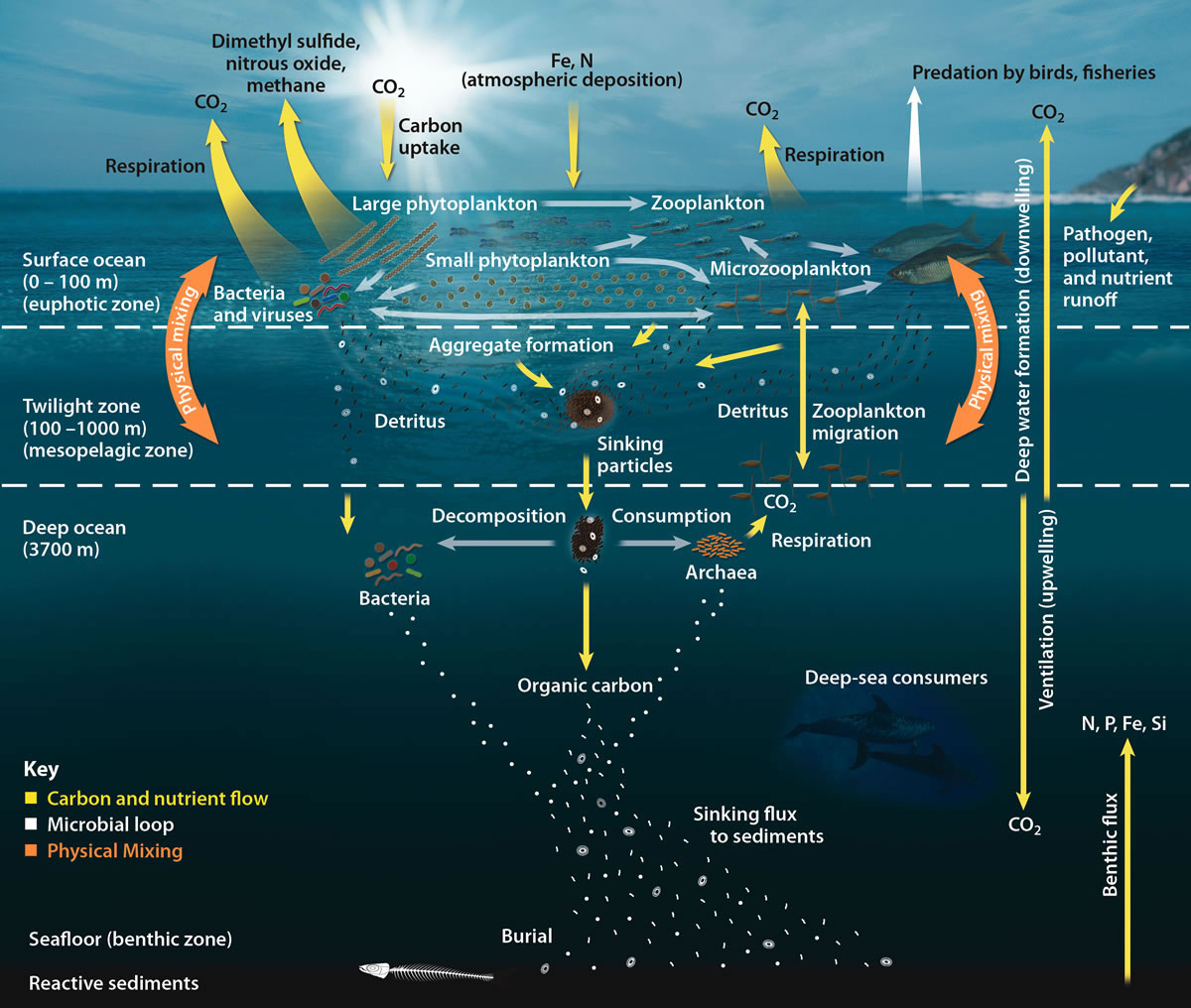
Many mesopelagic organisms make a daily migration through the water column - up in the evening  down at first light
  .
.
down at first light .
This transfers #energy from the productive surface waters to the dark depths below and acts as a "biological pump" that locks away huge quantities of #carbon 
Lanternfish (myctophids) are particularly abundant  They are a key link in marine food webs, feeding on plankton before falling prey to tuna and other commercially important species
Photo credit: © Paul Caiger, @WHOI

They are a key link in marine food webs, feeding on plankton before falling prey to tuna and other commercially important species Photo credit: © Paul Caiger, @WHOI
Lanternfish have escaped our attention for decades because they were hard to catch & process (plus they taste bad and contain toxins), but technological advancements make it possible to turn them into fishmeal & high-value omega 3 supplements 
History is replete with examples of #fish stock collapse, but mismanagement of mesopelagic fisheries could have profound global ramifications (see previous re carbon cycle & food webs!)
 The #UN Convention on the Law of the Sea (UNCLOS, 1982), the "Constitution for the #Ocean", gave all States the right to fish in international waters, but included little guidance on environmental protection.
The UN Fish Stocks Agreement (1995) resulted in the creation of Regional Fisheries Management Organisations (RFMOs), but they have generally focused on managing a handful of stocks and have been criticised for opaque decision-making & failure to protect #biodiversity.
The #UN Convention on the Law of the Sea (UNCLOS, 1982), the "Constitution for the #Ocean", gave all States the right to fish in international waters, but included little guidance on environmental protection.
The UN Fish Stocks Agreement (1995) resulted in the creation of Regional Fisheries Management Organisations (RFMOs), but they have generally focused on managing a handful of stocks and have been criticised for opaque decision-making & failure to protect #biodiversity.
E.g. Over 15 years have passed since the UN called for States to "urgently adopt" measures to protect vulnerable ecosystems from bottom trawling, but a recent @DeepSeaConserve assessment found that there is still a long way to go. http://www.savethehighseas.org/resources/publications/preventing-biodiversity-loss-in-the-deep-sea-a-critique-of-compliance-by-high-seas-fishing-nations-and-rfmos-with-global-environmental-commitments/
International law requires a State to seek RFMO approval for a new #fishery, but a proposal would not be subject to a thorough environmental assessment and stakeholders have no opportunity to provide input or object.
Only States with an economic interest get a seat at the table. This effectively leaves the governance of mesopelagic fisheries, and the fate of the globally significant ecosystem services they provide, in the hands of a few fishing States.
Negotiations for a new #highseas treaty are currently ongoing, providing an opportunity to reinforce environmental obligations. But negotiations are delayed & it will be years before an agreement has any impact on the water https://tinyurl.com/yxq6leps
Other options could focus attention on the issue, e.g. development of international guidelines (like the @FAO guidelines for deep-sea fisheries) and UN resolutions, but are unlikely to result in effective management in the absence of further efforts.
That’s why some deep-sea scientists are calling for a moratorium on fishing to give them time to advance their research before exploitation begins. https://www.nature.com/articles/d41586-020-00915-7
A range of scientific projects are underway to shed light on the twilight zone 


 @WHOI @Ocean_JETZON @COMICS_Carbon @SUMMERH2020 #MEESO
@WHOI @Ocean_JETZON @COMICS_Carbon @SUMMERH2020 #MEESO
The @PacificCouncil, which manages #fisheries on the west coast of the US, has already prohibited fishing for mesopelagic species until they can understand the potential impacts. https://www.fisheries.noaa.gov/action/fisheries-west-coast-states-comprehensive-ecosystem-based-amendment-1-amendments-fishery
There are precedents for such a moratorium at the global level, most recently an international agreement to protect the Central #Arctic Ocean The CAO Agreement ensures that fishing doesn’t start until proper regulations are in place.
https://arctic-council.org/ru/news/exploring-the-arctic-ocean-the-agreement-that-protects-an-unknown-ecosystem/
The CAO Agreement ensures that fishing doesn’t start until proper regulations are in place. https://arctic-council.org/ru/news/exploring-the-arctic-ocean-the-agreement-that-protects-an-unknown-ecosystem/
Opportunities to advance our scientific understanding & establish effective governance mechanisms are on the horizon, e.g. through the #highseas negotiations & the @IocUnesco #OceanDecade.
https://oceandecade.org/
https://oceandecade.org/
Given the role of mesopelagic ecosystems in the carbon cycle and food webs, one thing is clear: we need to understand and protect the #Ocean’s twilight zone, before it’s too late.


