
 Read on Twitter
I love attending the @forarthistory #globalnewvoices conference this afternoon! So many interesting papers about the invisibility/visibility of craft and whose work is being seen and held in high regard, vs whose work is “othered”. Some brief thoughts...
Hampton Smith’s exploration of trompe l’oeil jacquard portraits - “the deception only works by erasing the labour it requires”. I love that the weaver of this jacquard portrait of the loom’s inventor includes a symbol of workers’ anger and unrest #globalnewvoices
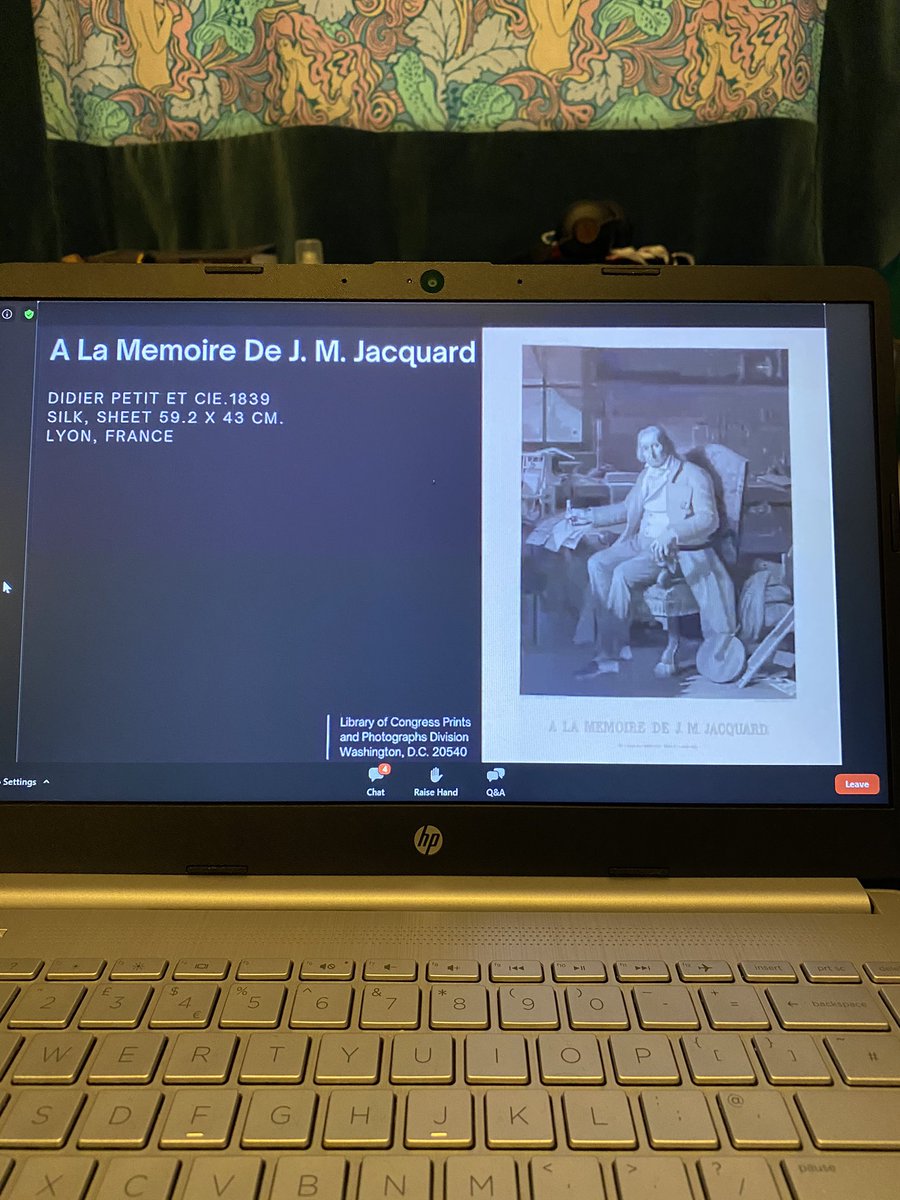

Smith also makes the important point that although the jacquard look is often hailed as a precursor to modern coding, it also ushers in a new age by allowing reproduction of work on a larger scale #globalnewvoices
Brenda Miller’s paper on the invisibility of commercial mending opened my eyes to an aspect of textile production I hadn’t even considered - the commercial mending of cloth during the production process in factories. #globalnewvoices
Even in modern factories, machines do not always produce a perfect product, and “quality control” involves menders checking each metre of cloth woven in heritage factories, then mending any faults by hand #globalnewvoices
Catherine Doucette’s paper raises an important point about the attribution of work from colonial workshops - skilled work was probably undertaken by enslaved workers, who were then bound to their former masters as “apprentices” before being fully emancipated #globalnewvoices
I adored Sarah-Joy Ford’s paper on Lesbian Quilts - it was performed as a beautiful and powerful poem instead of a traditional talk, and I immediately followed her on Instagram so I could see more of her gorgeous artwork! #globalnewvoices
Francesca Morgan’s paper on craftivism, social media and feminism was such an interesting and intersectional consideration of the work of craftivists on Instagram - who gets the time and the financial security to craft, whose work becomes popular? #globalnewvoices
An aspect of online craftivism that I hadn’t considered - Morgan suggests that artists leave their embroideries in the hoop to emphasise the work that has gone into crafting it, to show that it is a physical piece of work #globalnewvoices
Morgan also names one of the reasons I love craftivism and follow so many Instagram accounts - as well as being visible in the online space, it also exists as a tangible object in the physical space #globalnewvoices


