
 Read on Twitter
#CSPC2020 proper is starting now, & the first panel I'm looking at will be looking at #sciencediplomacy as a path to addressing global challenges with @_elke_d_ and @DrLMelchor as moderators. It'll be looking at specifically #scidip between the EU and Canada during the pandemic.
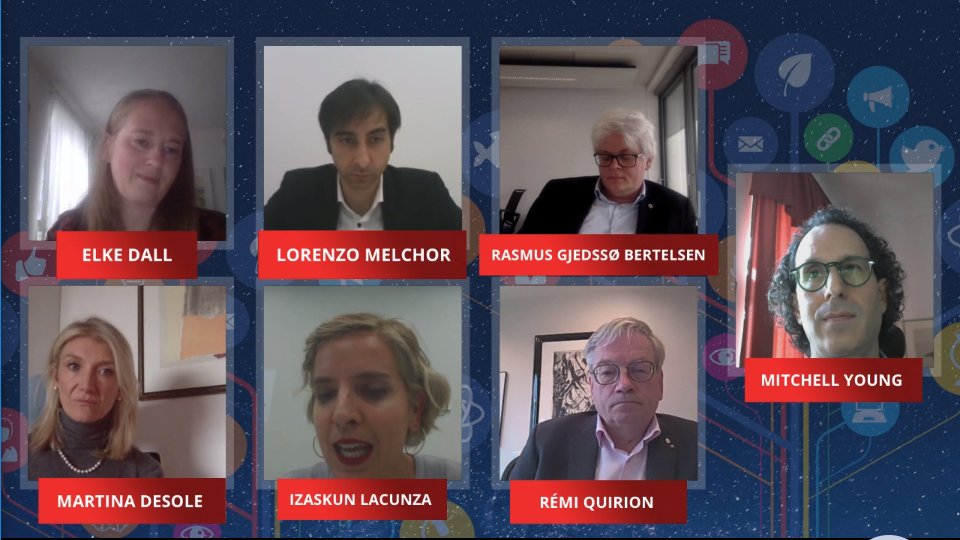
When asked to start the panel to talk about the relationship between Canada and the EU @MitchellMRY mentions that similarities in the two group's attitudes are first to come to mind - not being military superpowers requires them to look for other means of partnership.
@RasmusGB mentions the the old and deep ties between the two through the UK and French roots in Canada.
@ArunaMartina mentions shared values, especially a focus on #EDI towards a more ethnical approach to research that both groups are working towards.
@ArunaMartina mentions shared values, especially a focus on #EDI towards a more ethnical approach to research that both groups are working towards.
When the audience was asked to rank the top 3 scientific challenges for #scidip, they chose the following:
-climate change
-pandemic
-artic and ocean
Outside of science, the strength of -
- scidip was in shared willingness to tackle global problems and multilateralism.
-climate change
-pandemic
-artic and ocean
Outside of science, the strength of
- scidip was in shared willingness to tackle global problems and multilateralism.
@MitchellMRY mentions that global collaborations work best when you tackle problems so large that any one country cannot possibly tackle it on it's own.
In tackling these, unified messages are key ( #flattenthecurve!). In the pandemic we saw that at the beginning, but no longer.
In tackling these, unified messages are key ( #flattenthecurve!). In the pandemic we saw that at the beginning, but no longer.
It's expected that as events drag on, they get politized. The trick is to make the polarization of the science useful - to embed the science in policy in a constructive way.
Policy and science aren't all that different - there's cooperation and competition in both.
Policy and science aren't all that different - there's cooperation and competition in both.
He reminds us that understanding the similarities can help us direct efforts as 'power to cooperate' instead of 'power to force' - and that's where #scidip works it's magic.
@RasmusGB mentions that since the west won the cold war, it's had undisputed power which has given us the ability to set the agenda for a long time. But there's a problem with being undisputed for too long - the west is not in the same shape it used to.
"Oof" - @SciChefQC about the  election.
And despite issues with beliefs during the pandemic, science has never been as visible globally. #OpenScience, collaborations, etc have had renewed support this year - and the world turned towards solutions instead of problems.
election. And despite issues with beliefs during the pandemic, science has never been as visible globally. #OpenScience, collaborations, etc have had renewed support this year - and the world turned towards solutions instead of problems.
Remi does mention that there is still work to do - especially with increasing the involvement of the global south in this problem solving. It's something we haven't been doing enough of.
Also bring on board the citizen - not just the scientists and politicians.
Also bring on board the citizen - not just the scientists and politicians.
@ArunaMartina mentions that one of the success stories of - #scidip is that both sides invested in collaborations early - as @EU_H2020 and @CIHR_IRSC programs and doubled down on establishing new partnerships and pilots when needed.
- #scidip is that both sides invested in collaborations early - as @EU_H2020 and @CIHR_IRSC programs and doubled down on establishing new partnerships and pilots when needed.
@IzaskunLacunza mentions that #scidip isn't only a tool for science - it can help national competitiveness, national identity, etc. And that's what she's been working on with @s4d4c - which resulted in the #MadridDeclaration. https://www.s4d4c.eu/s4d4c-1st-global-meeting/the-madrid-declaration-on-science-diplomacy/
For my #scipolpals - Is the US central to EU-CA cooperation?
More than half of attendees said yes! We're definately a crucial partner on the global stage, and should continue to cooperate with our neighbors.
#scipolpals - Is the US central to EU-CA cooperation?More than half of attendees said yes! We're definately a crucial partner on the global stage, and should continue to cooperate with our neighbors.
@ArunaMartina reports that there have been more than 250 Canadian participants to the @EU_H2020
The profiles are open too, so you can check out what they're doing https://ec.europa.eu/info/funding-tenders/opportunities/portal/screen/opportunities/horizon-dashboard
The profiles are open too, so you can check out what they're doing https://ec.europa.eu/info/funding-tenders/opportunities/portal/screen/opportunities/horizon-dashboard
@RasmusGB mentions that one of the easiest ways to foster - #scidip is to simplify the process by which #gradstudents can travel between - (and the rest of the world) for their research.
And make sure this transfer isn't just to educate - it's to listen to the world too.
- #scidip is to simplify the process by which #gradstudents can travel between - (and the rest of the world) for their research.And make sure this transfer isn't just to educate - it's to listen to the world too.
@IzaskunLacunza mentions that she is a fan of the EU research frameworks - a common put of money with common rules that allow the world to collaborate and compete.
International programs tend to foster more productive global collaborations and networks than national ones.
International programs tend to foster more productive global collaborations and networks than national ones.
@SciChefQC and the Quebec Research Fund built a new program to fund #postdocs in #Scidip. And while they thought it would be mostly policy people applying - they have seen life and physical scientists get hooked on diplomacy.
the program http://www.frqnt.gouv.qc.ca/en/espace-presse/nouvelles-et-communiques/nouvelle/partnership-agreement-to-foster-the-contribution-of-new-researchers-to-science-diplomacy-sdgpav7v1525720221761
the program http://www.frqnt.gouv.qc.ca/en/espace-presse/nouvelles-et-communiques/nouvelle/partnership-agreement-to-foster-the-contribution-of-new-researchers-to-science-diplomacy-sdgpav7v1525720221761
The challenge is 'how do you build a #scipol collaboration without norms?' - @MitchellMRY
The world is a lot less western now - so shared norms aren't a stepping stone anymore. And we need to learn rebuild our #scidip language for a broader audience too. (& yes, is diff now)
The world is a lot less western now - so shared norms aren't a stepping stone anymore. And we need to learn rebuild our #scidip language for a broader audience too. (& yes,
is diff now)
Knowledge & science is said to cancel out power, but it is important to remember that science is extremely expensive. So if you don't have power, you need an outsider funder.
The US has historically has been a key global funder, so bringing them back in is important. - @RasmusGB
The US has historically has been a key global funder, so bringing them back in is important. - @RasmusGB
@SciChefQC says that even with the president-elect, the world may have to get used to not having the US at the table, writing the check.
Scientists have to learn the language of policy, and vice versa. We have to start understanding each other.
Scientists have to learn the language of policy, and vice versa. We have to start understanding each other.
With that, I thank all the panelists for a really interesting talk and a lot to think about. Looking forward to a more connected science landscape, and seeing science and policy integrate more deeply in the coming years.


