
 Read on Twitter
xG has nothing to do with outcome. Only location of the shot
Imagine you have data for a million shots. An xG model is taking all the shots with similar variables and seeing what % of them resulted in goals. This becomes the probability of the shot in that location being a goal. https://twitter.com/Rene_Pizorro/status/1296224283778330627
Imagine you have data for a million shots. An xG model is taking all the shots with similar variables and seeing what % of them resulted in goals. This becomes the probability of the shot in that location being a goal. https://twitter.com/Rene_Pizorro/status/1296224283778330627
The easiest example is penalties. Depending on competition, between 74 to 83% of penalties result in a goal. Let's say 80% for simplicity.
That means a penalty has an xG of 0.80. Or 0.8 xG.
That means a penalty has an xG of 0.80. Or 0.8 xG.
A shot on target is anything that will result in a goal if not prevented by the keeper. If a defender blocks it instead - it is a shot blocked, even if it would have been on target. If it hits the post - it didn't need the keeper to prevent a goal. Therefore it is not 'on target'
Post-shot xG is the xG value of shots based on where they are placed. So remember that sturridge screamer against Chelsea - it had an xG of about 0.02. As in 2% of shots from there results in a goal.
But the post-shot xG was much higher - lets say 0.60 (number out of ass).
But the post-shot xG was much higher - lets say 0.60 (number out of ass).
This is to say 60% of shots from there put in the top corner results in a goal.
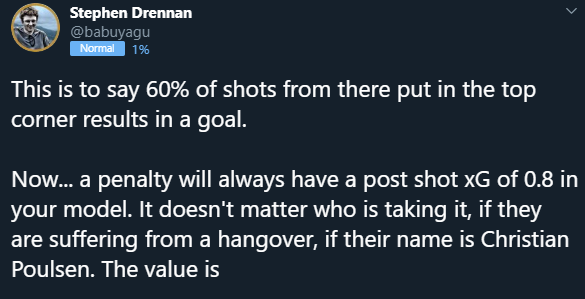
Now... a penalty will always have a post shot xG of 0.8 in your model. It doesn't matter who is taking it, if they are suffering from a hangover, if their name is Christian Poulsen. The value is
Now... a penalty will always have a post shot xG of 0.8 in your model. It doesn't matter who is taking it, if they are suffering from a hangover, if their name is Christian Poulsen. The value is
calculated before the ball leaves the player's foot.
However, it can have a post-shot xG of anything from 0 to 1. Only on-target shots can have a post-shot xG above 0.
If it's blocked = 0. Hits the post = 0. Of target = 0. Hits the moon = 0. If a shot isn't on target then it
However, it can have a post-shot xG of anything from 0 to 1. Only on-target shots can have a post-shot xG above 0.
If it's blocked = 0. Hits the post = 0. Of target = 0. Hits the moon = 0. If a shot isn't on target then it
has a 0% chance of being a goal. How close it is to being a goal is irrelevant - it is either on target on not. So if a shot hits both posts and then goes out for a corner - that is a post-shot xG of 0.
Correction to this tweet = it should read
A penalty will always have a (pre-shot) xG of 0.8.
Remember - xG is before shot leaves foot. Anything is possible.
Post-Shot is calculated on final placement in the goalmouth.
A penalty will always have a (pre-shot) xG of 0.8.
Remember - xG is before shot leaves foot. Anything is possible.
Post-Shot is calculated on final placement in the goalmouth.
https://twitter.com/ournumberfour/status/1296276372424257537
Think of xG like this.
Before you start a game of Russian Roulette, you have a 50% change of being shot in the head. An xD of 0.5
If the guy goes off while pointed at your head, you have an xD of between 0 and 1.
If pointed at the other guy, it's 0.
Think of xG like this.
Before you start a game of Russian Roulette, you have a 50% change of being shot in the head. An xD of 0.5
If the guy goes off while pointed at your head, you have an xD of between 0 and 1.
If pointed at the other guy, it's 0.
*gun
Your xD when pointed at you depends on where the bullet hits. Glances your cheek then it's pretty low. Hits you anywhere vital, going to be really high.


